
Death Valley certainly qualified as desolate but it also attracted the tourist hordes too. I wanted to explore something much more isolated after that, where fewer people ventured. I also wanted to add three more destinations to my county counting list. And they were a nice trio of gloriously large additions to my map: Nye, Esmeralda, and Lincoln Counties in Nevada.
This was a completely inefficient path between Death Valley and Las Vegas. However, that was exactly the point. I wanted to travel through some of the least densely populated parts of the United States outside of Alaska.
Rhyolite
I stopped first in Rhyolite. This is an honest-to-goodness ghost town that boomed briefly during the early 1900’s, standing totally abandoned for the last century.
Miners
The name comes from a type of rock although miners wanted gold not rhyolite. But the good times lasted barely five years and then the town collapsed. That was the nature of boom and bust in the Nevada desert during that period.

The train depot ruins form the largest remaining structure. Unbelievable as it sounds today, three separate railroads served Rhyolite during its golden age. Five thousand people lived nearby circa 1908 and they needed transportation, both to get supplies in and get minerals out. It made sense to build a railroad depot befitting a growing city. Well, it made sense until the population crashed and everyone scattered. Then it made no sense at all.

If Rhyolite has an iconic ruin it’s probably the John S. Cook & Co. Bank building. It was quite stately and even luxurious during its peak, with its mahogany details, Italian marble, and stained glass windows. Only stone remains today, the rest stripped and removed long ago.
It is frequently photographed and sometimes stands-in as a dystopian ghost town in Hollywood movie sets. So you may have seen it before without even realizing it.
Artists
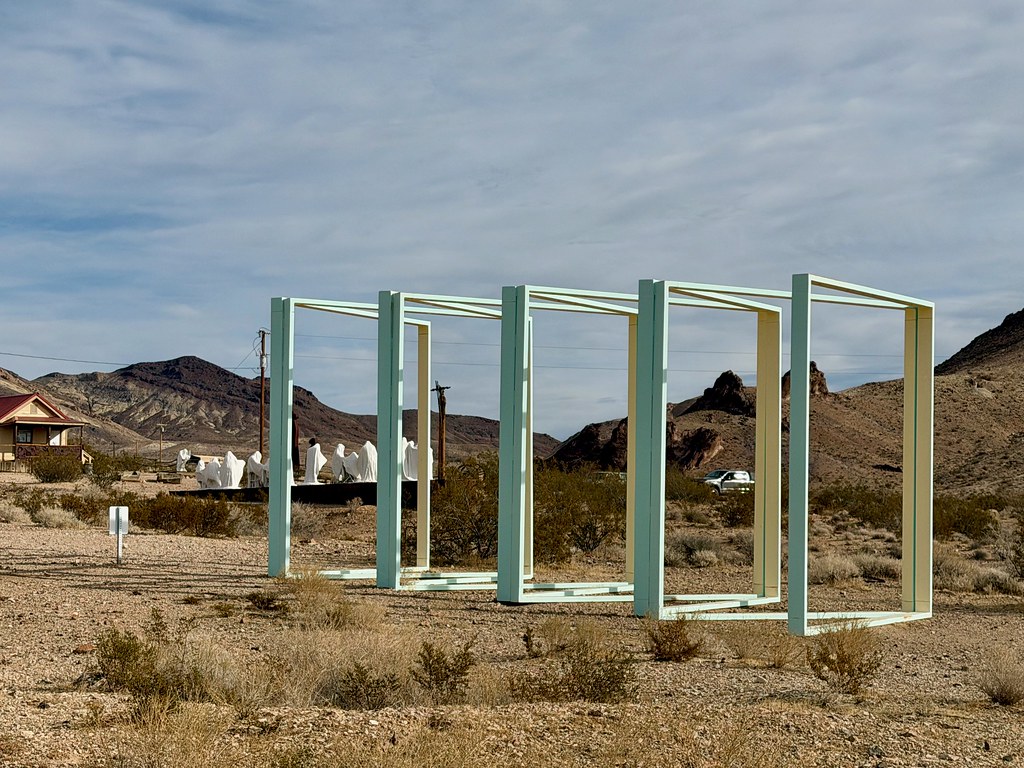
Just outside of Rhyolite proper, but on the way, stands the Goldwell Open Air Museum. It features works from several artists along the desert floor, out there in the natural elements. Open Air is an apt description.
People think differently in these remote corners so, sure, let’s put an art museum on a gravel hillside outside of a ghost town. Visitors can wander freely between sculptures at will. I stopped to enjoy it and I’m sure others do too.
The location practically guarantees a continuous trickle of visitors because anyone heading into Rhyolite passes right by it. I guess that’s why they located it there instead of some other random patch of desert. Still, it’s an odd juxtaposition when twinned with the abandoned town, but also offers a convenient twofer as far as roadside attractions go. Come for the ghosts; stay for the art.
Beatty

Only a handful of miles separate Rhyolite from the nearest actual functioning town, Beatty. Both settlement trace back to the same basic time period and for similar reasons. However, Beatty managed to hang-on long enough to survive for a different purpose. It’s the “Gateway to Death Valley” and tourism fueled the economy after mining failed. A number of hotels and motels line its primary street, and they are a lot cheaper than the Death Valley resorts. So it attracts a certain budget-conscious traveler who doesn’t mind driving an hour back to the national park.
Gasoline is also available here, and refueling opportunities are few and far between, sometimes separated by more than seventy miles. We made sure we filled up in Beatty.
Goldfield
Nothing is near Goldfield. Nothing. And that’s what attracted me.
It’s not even a crossroad, just a blip on a curve along Route 95 between Beatty and Tonopah, where the speed limit drops suddenly to 25 mph. This is about the closest thing to a ghost town without actually being a ghost town.
I promised myself in 2011 that I would visit Goldfield someday, and I finally fulfilled that. I didn’t realize it would take 15 years.
Boom
Goldfield follows the same story arc as every other gold rush town in this corner of the Nevada desert. The town boomed in the early 20th Century and crashed equally hard when the payday ended a few years later. More than twenty thousand people lived in Goldfield at its peak. Crazy as it sounds, it was once the largest city in the entire state of Nevada. Now the population stands at about 225.
Bust

Goldfield is also the seat of government for Esmeralda County, which declined in a similar manner and now houses about 725 residents. This is one of those places with more land than people. The population density barely measures 0.2 people per square mile. So each resident has five square miles to roam without bumping into anyone else, statistically speaking.
Now
A few large structures still stand in the nearly nonexistent downtown but only the county courthouse hasn’t been abandoned. The high school closed in the 1950’s and remains empty (above). The old Goldfield Hotel closed even earlier. Buildings in dilapidated condition vastly outnumber usable spaces. This is a hotbed location for crews filming those cheap ghost hunter television programs.
However, notice the roof on the school. It’s modern. Preservation effort are underway to save some of Goldfield’s key historic structures while they are still salvageable. But it’s a race against time.

Unfortunately, most of the town looks like this. Neglect and decay continue to gnaw at buildings of lesser historical value. Debris litters abandoned lots, and not just the remnants of buildings either. The markers of daily life remained behind too, including junked automobiles, household appliances, and mining equipment. People occupy a few houses of course, spread amongst the wide fields of detritus. A lot of residents also seemed to live permanently in trailers and RV’s.

Here, once again, desert isolation either creates or attracts personal idiosyncrasies. Art cars? I’m there for it.
We stayed overnight in Goldfield so I had plenty of time to explore and walk along the grid of its nearly abandoned streets. It was otherworldly. I didn’t see any ghosts. In fact I barely saw any living people on this cold, windy November morning.
Tonopah
Tonopah is doing a little better, well actually a lot better, with about ten times Goldfield’s population. This is the Big Deal town out here in the middle of nowhere. It seems to sit in a favorable geographic position: about halfway between Reno and Las Vegas. Anyone traveling between Nevada’s two population centers will drive right through Tonopah.
The town also attracts some tourism and it sits close to a military base so there are jobs available. It has some positive things going for it.
Tonopah Historic Mining Park

Like everything else out this way, Tonopah existed for mineral extraction, although primarily silver here. And once again, the rush began in the earliest part of the previous century. Fortunately, many historic artifacts survive, preserved within the Tonopah Historic Mining Park. The site encompasses a trio of mines that once operated on the hills above town.
Tonopah Cemetery

Lots of people died in those early years, maybe from mining accidents or gunfights but mostly from disease. Many of them found their way to Tonopah Cemetery, a barren field of gravel and dust. They came to Nevada to find their fortunes but never got rich and never left. The tombstones are modern — the original wooden markers would have rotted decades ago — so compliments to Tonopah for its attention to detail.
Clown Motel
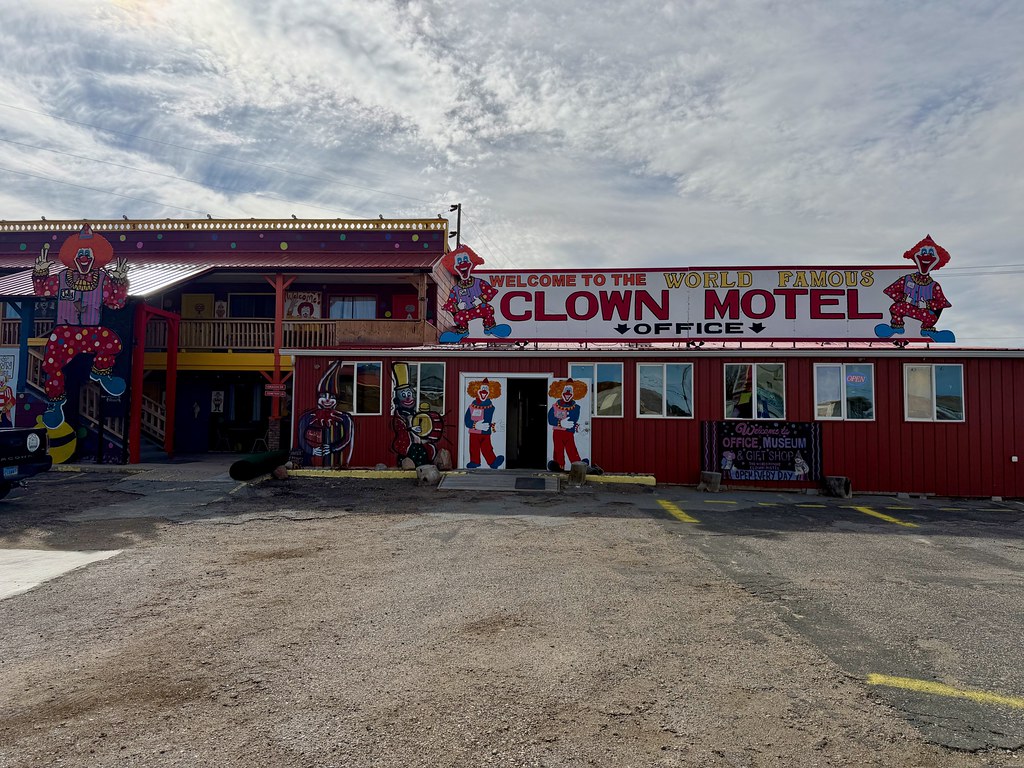
If anyone wants to get creeped-out even further, they can stay overnight at the “world famous” Clown Motel overlooking the cemetery. Each room has its own unsettling clown motif, some bizarre and some truly frightening. It’s another one of those favorite properties for ghost hunting shows.
Stay away if you dislike clowns because there are several thousand images and figurines scattered throughout the property. I was happy enough to remain on the outside. I can’t imagine staying overnight although many travelers enjoy the thrill.
Bonus Oddity: The Extraterrestrial Highway

Refer back to my route map at the top of the page and notice that it circles around a bunch of empty interior Nevada. Well, it’s not entirely empty. The U.S. government takes advantage of the remoteness by operating its Nevada Test and Training Range there. And more specifically, within that property is an even further restricted facility, the infamous Area 51.
Whether the government is hiding alien Unidentified Flying Objects (UFO) or Unidentified Anomalous Phenomenon (UAP) within that void is something for others to decide. I just know it’s a great spot for wacky roadside attractions. So my route included the entire length of Nevada Route 375, the “Extraterrestrial Highway.”

Alien kitsch concentrates at a couple of stops along the highway. The bigger cluster centers on the town of Rachel which isn’t much more than a small collection of homes and trailers jutting from the desert floor. Here, the Little A’Le’Inn is the star of the show, with a restaurant, a bar, and a motel, plus abundant plastic aliens. It covers most every need except for fuel. However, that’s easily remedied at the nearby Alien Cowpoke Gas and Mini-Mart.
Then, about another half-hour down the road near Hiko, sits the Alien Research Center which is actually just a large gift shop despite the name. Unfortunately it was closed on our random November Monday when we drove past, but we did stop for outdoor photos with the various aliens attractions.
I love this kind of stuff.


Leave a Reply